Gamification design proposal - Mobility app
Role
Product designer
Duration
August - October 2023
Team
Growth team PM - Developers
I design a complete gamification proposal, from research to final UI, for a transport app. The goal was to increase user engagement on the main app and offer gamification packages to white-label products for potential clients. Therefore, the proposal had to be modular, simple, and scalable.
Contexto
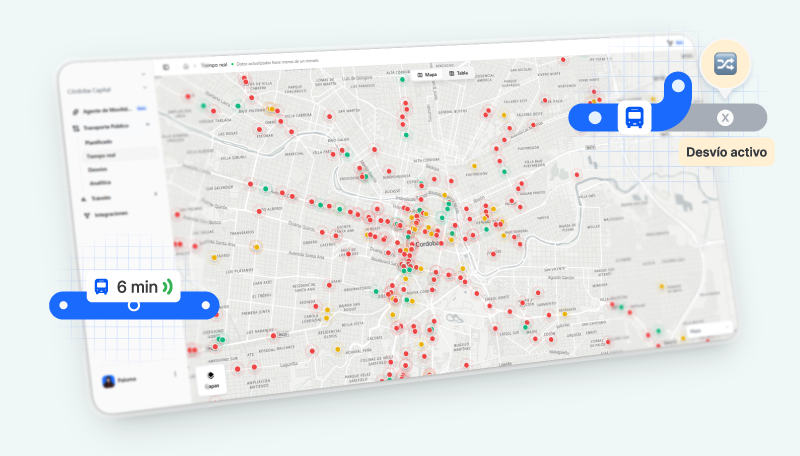
The product had a stable and growing daily user base, but was struggling to retain those users. It also had multiple features related to point accumulation, user statistics, and personal profiles that were completely underutilized and served no clear purpose within the app that would benefit the user in their daily use, in fact, they caused confusion. The goal was to unify all those existing elements to gamify the experience, deliver real value to the user, and increase weekly and monthly retention.
Designed to be separated into blocks, with white-label sales to clients in mind
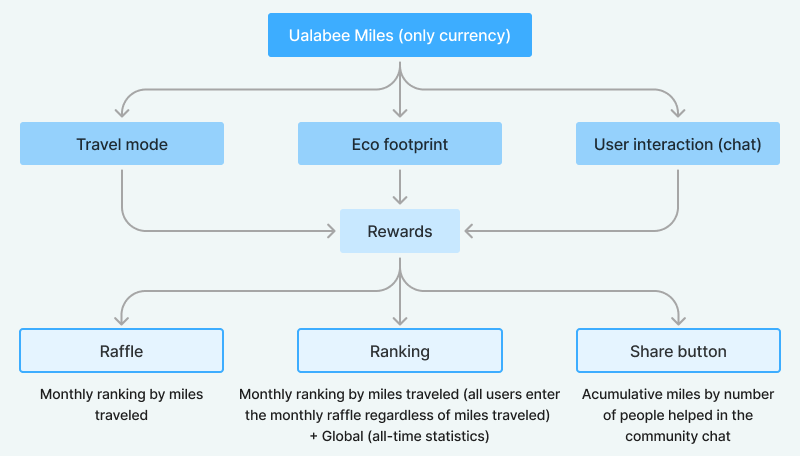
Unify all existing elements into a single ecosystem
Connect all elements to create synergy between them
Proceso de diseño
UX research
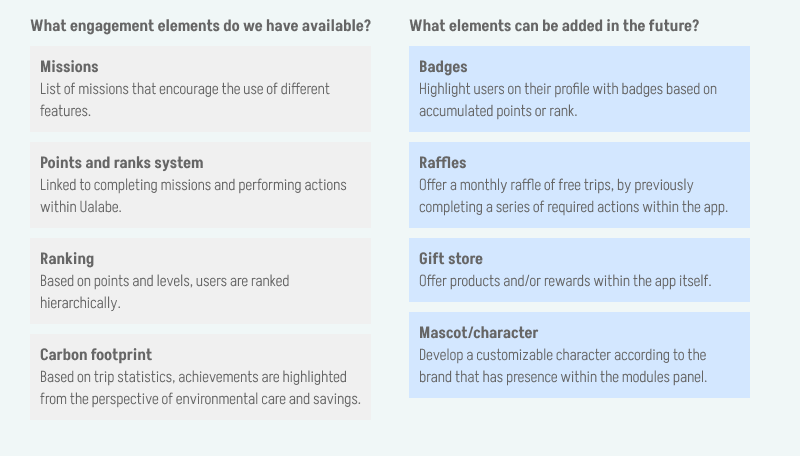
The first step was conducting a benchmarking analysis of similar applications that incorporated gamification features into their UI and user flow. Across the studied cases, the most successful mobility apps don't just reward usage, they build an identity around it. Branded naming conventions, user avatars, ranking systems, and point-based progression were the most consistently recurring elements, all working together to make users feel like participants in a community. When mapped against Ualabee's existing features, the building blocks were already there: missions, points, rankings, avatars, even carbon footprint tracking, but they were operating in isolation, without a coherent narrative connecting them.
Wireframes
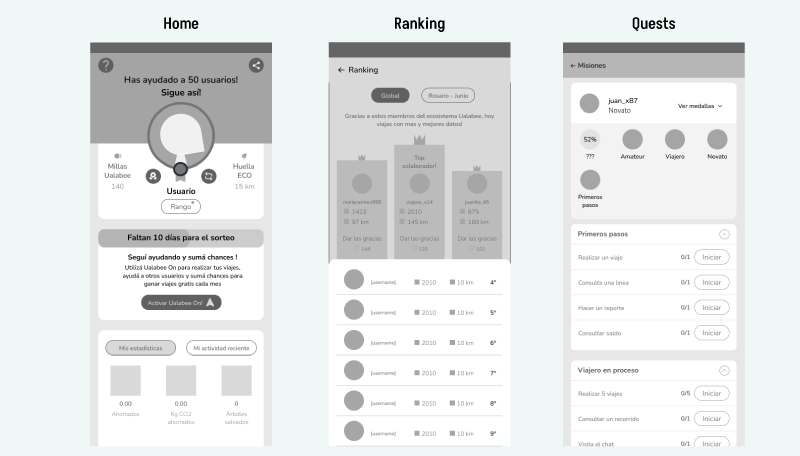
The first UI sketches focused on organizing all existing gamified elements into a single screen that would serve as the user's main profile. From that central screen, secondary screens were designed to correspond to each type of currency the user could accumulate.
- Gamification home: a gamified ecosystem representing the user.
- Ranking: user standings based on miles earned, both globally and by city.
- Missions: an adjacent way to accumulate miles and increase the user's rank.
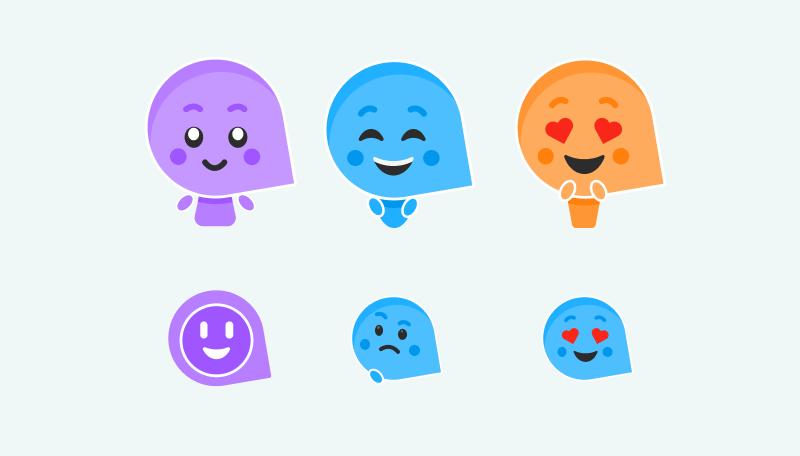
Avatar: introducing the "Ualame"
A representative character was designed so users could have their own identity within the gamified ecosystem. Since the company's name is Ualabee and the character is a representation of the user, the concept "Uala + me" = Ualame was born. Its shape also draws from the identifying element of the company's logo. The character would serve as the user's face within the app and could be randomly generated from the home screen, with a customizable color.
- User identity as part of a community.
- Integration into the company's brand universe while differentiating from competitors.
Changes and iterations
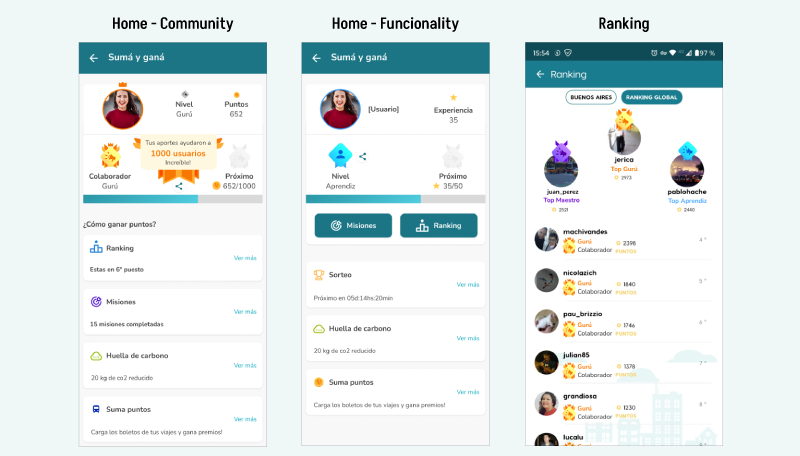
As with any project, the proposal was interrupted by a shift in product priorities. Building such a complex universe was no longer viable given that the goals for the next quarter had changed, so work began on a simplified version. It was decided to split all gamification elements into two areas, community and functionality, allowing each type of client to choose the gamification focus that best aligned with their primary objective with the app.
- Community: strengthen the sense of user community to build loyalty.
- Functionality: encourage daily use of the app's core tools.
Ranks and badges
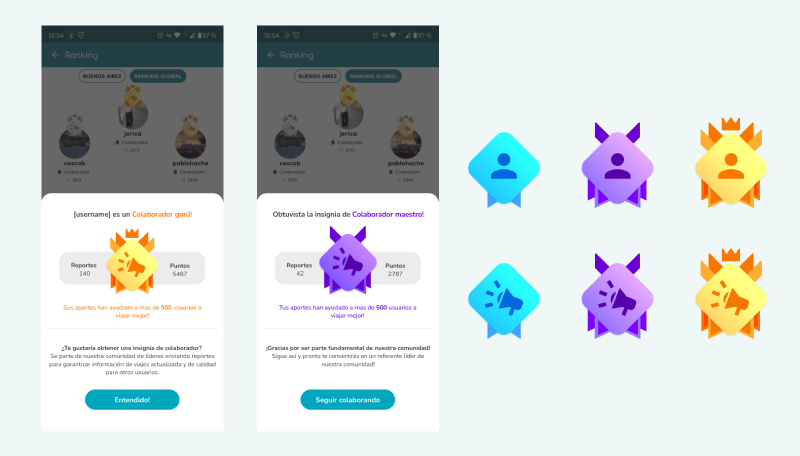
A rank system was designed for users depending on the chosen gamification focus. For the community path, rank increases proportionally to the number of users helped in the chat. For the functionality path, rank increases through daily use of the app's tools.
Impacto
This project shifted how I think about gamification: a system where every element needs to earn its place. The real work wasn't designing new mechanics, but making existing ones coherent enough to actually drive behavior. It also reinforced that modularity is a design decision with business consequences. Building a system flexible enough to be split into community and functionality tracks opened a commercialization path that a broader approach never could have.
+10 in gamification strategy
+5 wireframe production
+5 data-driven design